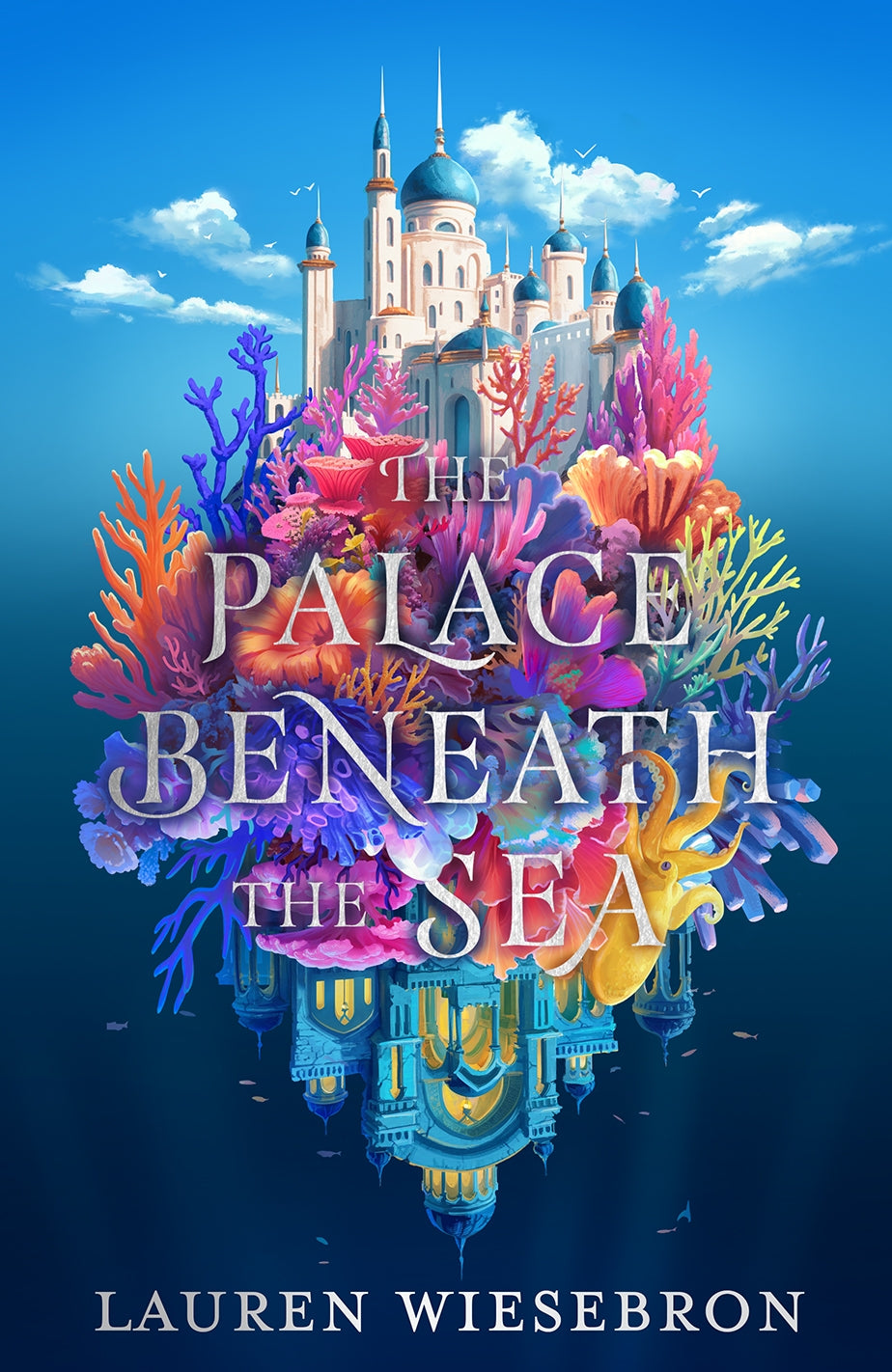
As lush as it is lyrical, The Palace Beneath the Sea is an atmospheric retelling of the legendary lost city Ys, following two lovers and their connection between two different worlds – one on land and one beneath the waves. Written by marine biologist Lauren Wiesebron, here she tells us how the pull of the ocean, and the secrets of the deep, influenced her writing of this beautiful love story.
Standing before the ocean is one of the most humbling and awe-inspiring experiences I can think of. I remember, at the beginning of the six-week voyage on a three-masted brigantine, the moment when I realized that the closest land to me was the seafloor buried under four kilometers of water. As the boat pitched and yawed in the waves, I felt keenly the truth that we could not turn back if (when) I got horribly sick. We were alone, an island at sea, a small community of thirty souls with only a thin strip of wood separating us from four kilometers of oblivion. Humans are not at home in the water. It was so strange, to want to live at sea on a boat in an environment that is decidedly not our home, that is deadly to us. And yet, we did it, and we were so excited to do so. We thrummed with the opportunity to learn, to adventure, to experience. But why? Why put ourselves in so precarious a position?
We are always drawn to the sea. Our cities are on the coasts, hugging the oceans. And yet, we cannot impose our will on the ocean as we do the land, our home. The ocean is a wild place of the subconscious, bigger and stranger and crueler than the dense forest of fairy tales. It is much less human. But it has always drawn our awe and our imaginations. It’s the place where monsters crawl at the edge of the map.
Marine science is full of mysteries that I loved to explore while writing The Palace Beneath the Sea. When thinking about the social structure of the korrigez of my novel, the mer-people hailing from Brittany, the Northwest tip of France, I wanted to incorporate something I learned about as a Master's student, which is that some fish can change sex with social cues. Most famously, a female clownfish rules over a group of male clownfish, and when the female dies, one of the male clownfish becomes female and takes control of the group. Scientists are still studying how this happens biologically, but what I was most interested in were the social ramifications. How would a society be structured if only a small number of individuals could reproduce, and changing sex prompted by social cues, was necessary to do so?

One other question that I thought a lot about was communication. Most deep-sea creatures produce their own light, called bioluminescence, to communicate. The mechanism and motivation of these missives is still a mystery, but since the korrigez are deep-sea dwellers, living near the seafloor in pitch-black darkness, it made absolute sense to me that they would create their own light as a form of communication. So yes, this novel is full of sex-changing, glowing mer-people. I had a lot of fun with this!


This novel was also an opportunity for me to dig into themes about nature and our relationship to it. While humans exploit the oceans, they do not impose any lasting structures on it unlike on land (at least, not yet. Deep-sea mining is coming for us, fast!). I thought of whether the korrigez, like humans, would build structures of their own and, instead, I imagined that the korrigez feed deep-sea corals which allows them to grow into superstructures like palaces. I loved thinking about the societal ramifications of such an arrangement and the fragility of existence that would result.

The ocean is full of riches and life. It has always attracted the hungry, and those who long for beauty. The ocean can even be a defense against invaders, the tides a source of energy. But a life on the ocean’s edge is no more than a shaky truce with nature. Especially when one takes at an unrelentless pace without giving nature the opportunity to replenish itself. It’s this uneasy truce I wanted to explore, this feeling that we can live next to the ocean, tame it with engineering and our human will, all the while knowing deep down that it would only take an enormous wave for our structures to fumble, our dams to break, a leak to spring in the hull of a ship and the ocean would swallow us whole.
This push and pull towards the ocean – fascination and love for its mysteries and bounty, but also the knowledge deep in our bones that it is an alien place, fundamentally incompatible with our biology – made the deep, coastal ocean a perfect place for a story about love and betrayal. Just as the ocean shaped my characters’ cities, it mirrors their warring desires. The same forces that pull us toward the ocean: curiosity, longing, the desire to cross an impossible boundary – are the ones that push them toward self-discovery, transformation and, sometimes, devastating choices.